YayBlogger.com
BLOGGER TEMPLATES
Showing posts with label berries. Show all posts

Sunday, June 30, 2013

Saskatoon Raspberry Jam

I love nature. And I'm also that weirdo foraging berries in a park. People look at me and are like, da heck? Hey, stop staring, it saves me coin!

While I'm a native of Portland, Oregon, and while I (think I) know Portland like the back of my hand, I'm always discovering something new in the Portland Metro area. Sunrise Park, located in Troutdale, Oregon (close to the Sandy River as well as the Columbia River Gorge), is a neat little gem that I discovered only a few years ago. The view of Wy'East -- Mt. Hood's original Native name -- is stunning, and I've seen diverse wildlife at the park, including a Great Horned Owl, as well as Cedar Waxwings.

In a recent visit to Sunrise Park, something caught my eye that I had not noticed before: Saskatoons! (Amelanchier alnifolia). Saskatoons, based upon the Cree word for the plant, are known by other names such as Serviceberry and Juneberry, but it took me a while to identify them as I've never foraged for them before. As I tasted them for the first time, they reminded me of Salal with a slight almond taste, although they're much juicier. The juice stained my lips and left my fingers purple. (Unsurprisingly, the fruits are known to have been used as a dye historically by Native American Tribes, which I may try out sometime myself when dying some yarn... because that would be like, awesome, and stuff).

File:Amelanchier alnifolia 2802.JPG
 Saskatoons/Serviceberry (Amelanchier alnifolia). Photo from Wikipedia.


Saskatoons are fruits that are not exactly berries, but pomes, and were an important food staple for Northwest Tribes. They were eaten in a variety of ways, and often enjoyed fresh, dried, and mixed with pemmican. During the Lewis and Clark expedition, Meriwether Lewis documented the plant in the Dalles, Oregon. The fruits have medicinal properties and were historically used as such, aiding a variety of ailments.

As for my own adventures, I picked some of the fruits -- being sure to leave plenty out of each picking for Nature -- and went home, not sure of what to do with them. I didn't have enough for a pie, and I've been baking a ton of muffins lately, so something different was in order. After googling some ideas and finding this recipe, I decided to make a mixed jam with Raspberries from my garden. And it was basically the best decision, ever. Saskatoons are delicious!


Oh, yes.


For more information, please see:

Wild Berries of the West written by Betty B. Derig and Margaret C. Fuller

Edible and Medicinal Plants of the West by Gregory L. Tilford

American Indian Health and Diet Project


This post was written for educational purposes only. The information in this post is not intended to diagnose, cure, or treat any disease. Please see disclaimer: Not all berries are edible, and many are poisonous, so do not consume any berry/plant without being 100 percent positive of identification.


Tuesday, June 18, 2013

Gluten-Free Huckleberry muffins

Huckleberries, you say?


Okay, so it's a bit early to get excited for them as they ripen in late Summer, but Huckleberries, combined with baking, is a marriage made in Heaven. Few things smell better in life than Huckleberry  pie anything baking in the oven. I swear, it's like the ultimate power, to bake with those delicious berries.

Anyway, I used the last of the frozen Huckleberries I had left and turned them into the best muffins I've ever had (surely a stoner would agree, tossing their bag of Doritos out the window and hang onto the muffin tray for dear life). I used this recipe with a little modification, replacing regular flour with Bob's Red Mill Gluten-Free All Purpose Flour, added a teaspoon of Xanthan Gum, and then a tablespoon of Maple Syrup (for no reason other than that I lurve Maple Syrup).

For the topping mixture, I used half white sugar, and half brown sugar. I think the recipe would be great with other berries, too, and since Salmonberries are currently ripe, I just might make Salmonberry muffins next!

(On the note of foraging for wild berries, there's a lovely nursery rhyme that children of the Warm Springs and Umatilla Tribes sing: "One for the bear, One for the Coyote, One for the Bird, One for Me." Take one berry out of a few, to leave for Nature.)


Gluten-Free Huckleberry Muffins. 
Time to omnom.


Monday, June 25, 2012

Rubus Jam

After my disappointing experience with the meh-ness of wild Salmonberry jam, I decided to give the berry another chance. I want to love Salmonberries so badly; they're beautiful, are nutritious, and this time of year, they're everywhere in the Pacific Northwest. So, rather than return to Dabney State Park and avoid falling into Stinging Nettle (like the last time), I went back to the grove  I discovered locally, and began to pick.

As an excited forager, perhaps I was too hasty in my previous Salmonberry-picking. The berries I picked in the grove seemed a little more palatable... perhaps they were a little more ripe... although they're still not in the same league as the sole ripe Thimbleberry I was able to get my hands on. I picked a mug full of the golden beauties, and then returned home to make jam. Only, instead of having a 100 percent Salmonberry jam, I mixed it with another member -- albeit a more famous member of the Rubus genus -- tasty raspberries! I planted raspberry bushes in the garden a couple of years ago; best gardening decision I've ever made.


My recipe:

1 1/2 cups Raspberries
1 cup Salmonberries
some lemon juice
1 cup sugar
1 tablespoon of honey
a bit of pectin, if desired

Gently wash and pick over berries, and mash them in a saucepan. As they cook, add a bit of lemon juice (I added about half of a lemon's juice) and then I added 1 cup of sugar. Add a bit of pectin if desired, about two tablespoons or so. Bring the jam to a boil for several minutes. Turn off the surface, and allow the jam to cool before storing.

This jam works; there's no strange aftertaste, and it has just the right amount of tart.The end result of Rubus jam yields an absolutely delicious and fantastic jam. Booyakasha!


Saturday, June 16, 2012

Salmonberry Jam

After visiting Dabney state park for a hike, and seeing the golden Salmonberries (Rubus spectabilis) dispersed throughout the Sandy River's landscape, I was really excited to get my jam-making groove on and make a batch. The berries are simply beautiful with colors ranging from gold to salmon to scarlet.  Salmonberries were an important food source for northwest Tribes; historically, Native Americans ate the sprouts peeled, or steam cooked the sprouts with dried salmon. Rubus spectabilis served medicinal purposes as well for Native Americans.

For two days I hiked around the area to pick them -- carefully avoiding Stinging Nettle and spiders -- and after all that foraging, I couldn't wait to turn the berries into a jam, and spread the stuff on my toast.

Salmonberry at Dabney State Park, Oregon.


As for the flavor of Salmonberries, well, they vary in taste, and can be described as "insipid." While they've never had that "wow" factor for me, I never thought they were flavorless (in my experience, the taste can range from semi-sweet to "woodsy", but they can have a strange aftertaste).

Once picked, Salmonberries can get mushy. While not as delicate as Thimbleberries, they're best eaten right away, and I've read berry books (Janie Hibler's The Berry Bible) that state making a jam with them isn't recommended. Contrary to this, though, others have had success. I don't often use pectin when making jam, but I did use it while using this recipe.


Fresh Salmonberries, ready for jam-making.


Well, I finally made a batch, and as I tasted it, I felt a little disappointed. The flavor isn't bad per se, but it's  just.. meh. As with their fresh form, the jam likewise has that same interesting aftertaste... something I can't really pinpoint, but it's a bit of a bitter taste that sugar can't completely conceal. A different batch may yield a better flavor, but my culinary conclusion is that, while aesthetically appealing and also edible, Salmonberries don't make the best jam. Perhaps mixing the Salmonberries with another member of the Rubus genus (e.g., raspberries) would aid in making a better and tastier jam.

And yet, the soon-to-ripen Thimbleberry will be available (and those berries are simply delicious), so I'm starting to feel excited to forage once again.

For more information, please check out the book, Wild Berries of the West by Betty B. Derig and Margaret C. Fuller.

Sunday, September 11, 2011

Gluten-free Huckleberry Pie

Aassddfgghhhjj!!!

*Freaking out over excitement here*

To my absolute delight, I scored a large quantity of Huckleberries!

Of the Vaccinium species, some of the more common varieties are found in the West. Historically and presently, the berries are a sacred food staple of Northwest Native Americans, and are celebrated by the Warm Springs Tribe. Needless to say, Huckleberries are my favorite wild berry, as they're juicy and delicious. While they make a prize jam, few things smell better in life than Huckleberry pie baking in the oven!

Ingredients:

6 cups huckleberries
1 1/2 cups pure cane sugar
1 tbs. Oregon wildflower honey
4 tbs. cornstarch

Note: I froze the huckleberries after washing them, so the addition of water isn't needed. If they're fresh, add about 1/4 cup of water.

Use an 8" gluten-free pie crust obtained from Whole Foods, or make your own with Bob's Red Mill gluten-free pie crust recipe.

Preparation:

Preheat oven to 350 degrees. Thaw frozen berries, and then mash when ready. Add the sugar, honey, and cornstarch to the mixture. Heat in a saucepan to a boil until mixture thickens. When it cools, add to pie crust. Add the top crust and pinch the sides to seal. Add a little milk to pie crust to aid browning of the crust. Bake at 350 degrees for about 50 minutes.

(Recipe adapted from "Huckeberry Pie" receipe with my own modifications, from Wild Berries of the West by Betty C. Derig and Margaret C. Fuller.)


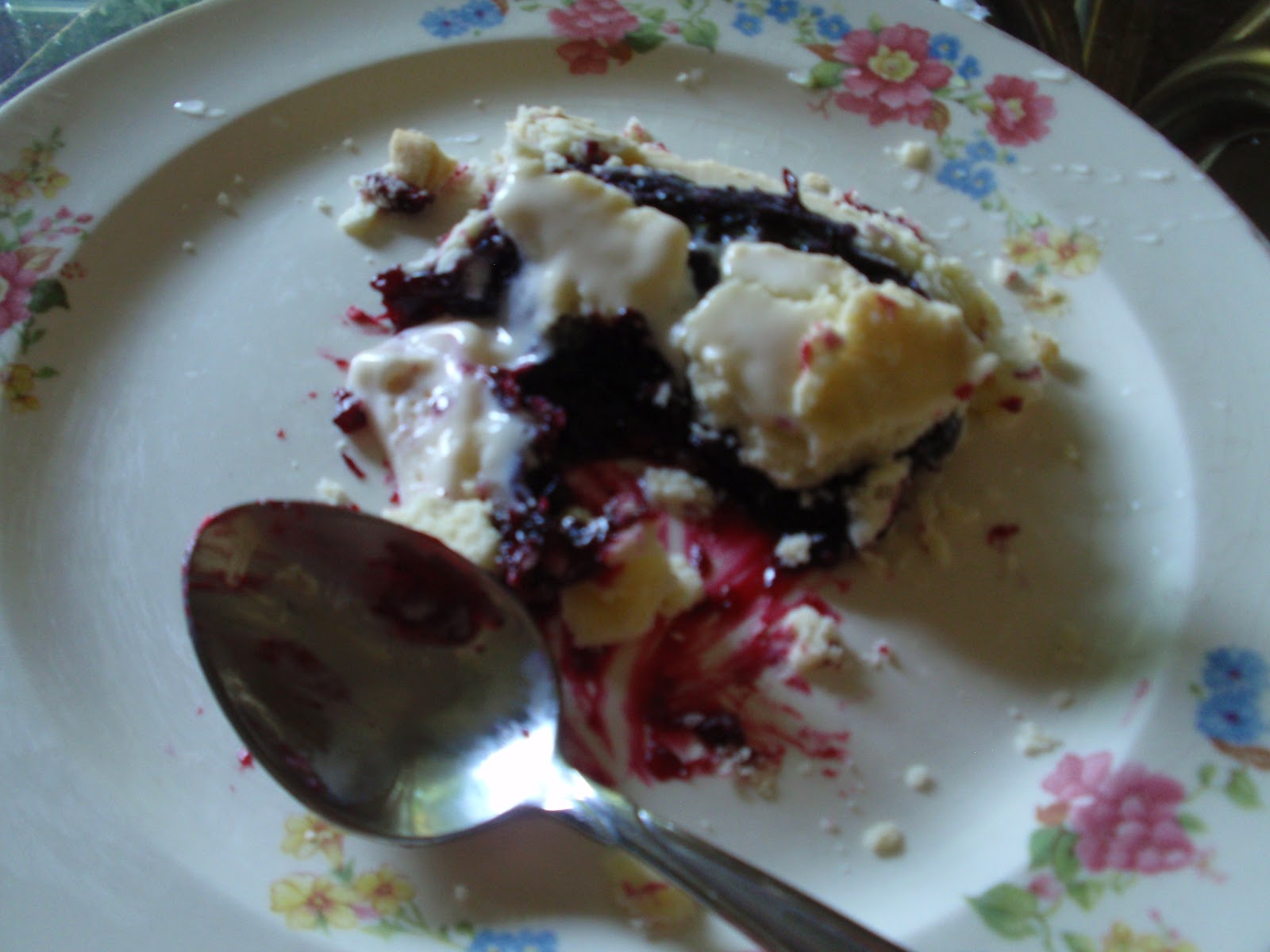
Partially consumed slice of the Huckleberry pie with ice cream.
I couldn't help myself and wait for a photo. Could you? ;)

Sunday, July 24, 2011

Foraging

Warning and disclaimer: Use common sense when messing with wild plants. Wild plants demand great respect and many are not edible. Never eat any wild plant or berries without 100 percent positive identification of edibility.


Like many other Portlanders, I have a great love for Mt. Hood, originally known as "Wy'East" by the Multnomah Native Americans. Back in my college days, I took a Geography of Mt. Hood course. The course was an adventure I'll never forget, and, since then, I've been fascinated by wild food sources. The stories of Lewis and Clark surviving on the food sources the Mt. Hood National Forest provided is especially cool to Oregonians.

But recently and unexpectedly, I had a pleasant surprise: I went on a local nature trek, and came across a path which led into a grove. The grove had a relatively clear path, and many different native plants were surrounding the area. After inspecting a particular berry bush, I was happy to realize the bush was a wild Thimbleberry bush; its berries not yet ripe. Near the Thimbleberry bush, however, was a Salmonberry bush, and its berries were ripe and juicy for eating. While the taste of Salmonberry has a more "relaxed" palate, Thimbleberry has an especially delicious taste. Furthermore, Thimbleberry is known to have medicinal properties. Unfortunately, the wild berries are seemingly scant.

I think there's something especially pleasurable about forging natural food sources. Foraging, I think, allows one to be in-tune with nature, and also, perhaps, able to be a little self-sufficient.


Rubus spectabilis (Salmonberry). 


If interested, and for more information, please check out the books:

Wild Berries of the West  by Betty B. Derig, Margaret Fuller, c2001

Edible and Medicinal Plants of the West  by Gregory L. Tilford, c1997